Forts, Blockhouses and Historic Sites
Where the history can still be seen
Aroostook County was created in 1839 as Maine sought to solidify its hold during the bloodless border confrontation known as the Aroostook War. Across the region, historic forts, blockhouses, and commemorative landmarks preserve the disputed boundary lines and early settlements of the borderlands. From military posts on northern rivers to historic schoolhouses and Acadian shrines, these sites highlight a defining era in Maine history.
 Your logo here
This page could be sponsored
Your business name here
Sponsor This Page

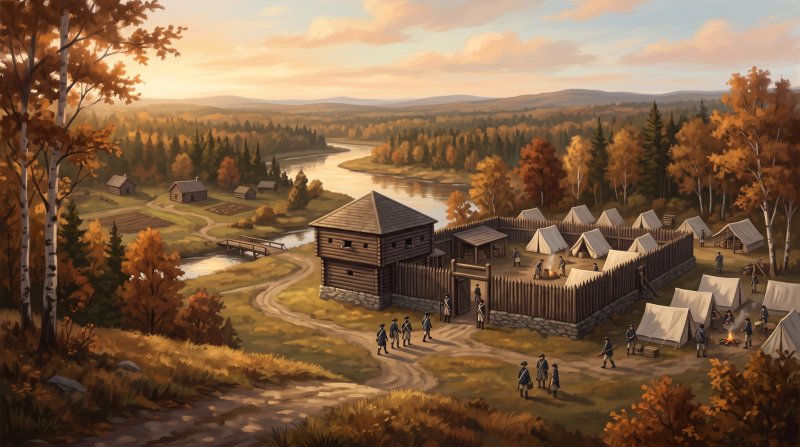
The boundary dispute that necessitated defense outposts across northern Maine stemmed from ambiguous border definitions in the 1783 Treaty of Paris. To protect its claims, Maine created Aroostook County in 1839 during the Aroostook War. That same year, the Fort Kent blockhouse was built from square-hewn cedar logs at the confluence of the Fish and Saint John rivers. Named in honor of Maine Governor Edward Kent, the post was initially held by a civil posse under Captain Stover Rines before Captain John Winder led federal troops to relieve them and complete the blockhouse, barracks, and officers' quarters. Today, this National Historic Landmark stands as the only surviving original fortification from the conflict. Acquired in 1887 by Bartlett W. Mallett and sold to the state in 1891 to ensure its survival, the property is a State Historic Site operated as a museum and maintained by local Eagle Scouts in cooperation with state parks officials. Nearby, the Fort Kent Historical Society preserves settlement memorabilia in the former 1912 Bangor & Aroostook Railroad station.
Along the Aroostook River, state and federal forces established Fort Fairfield in April 1839 to defend the boundary and prevent timber from being transported into British New Brunswick. Named for Governor John Fairfield, its civil posse operations were directed by Deputy Land Agent William Parrott. In 1976, the Frontier Heritage Historical Society constructed a replica of the 1839 blockhouse on Main Street. This replica now serves as a local museum displaying early artifacts, documents, and exhibits dedicated to the border dispute. Down in Houlton, military preparations had begun even earlier at Hancock Barracks, erected on Garrison Hill in 1828 where Major R. M. Kirby commanded three companies of the U.S. 1st Artillery Regiment. A historic marker stands there today on town and county land, while the Aroostook County Historical and Art Museum, founded in 1937, houses archives and a dedicated Military Room detailing the post.
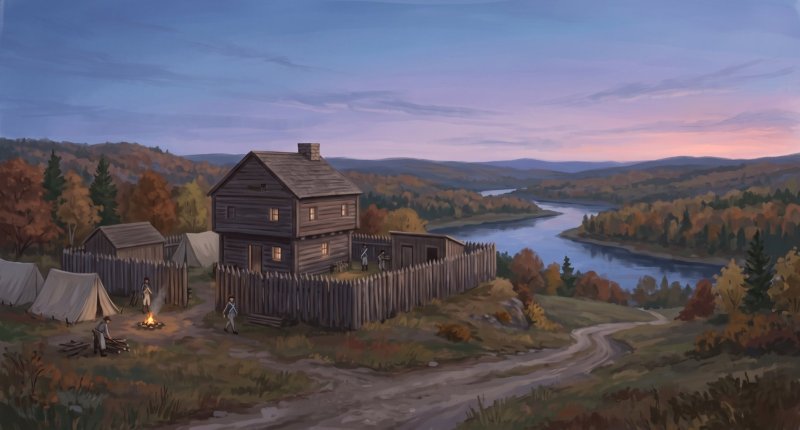
Traveling to historic sites in Aroostook County also brings visitors to the cultural roots of the Saint John Valley. In St. David, the Acadian Landing Site along the Saint John River marks where the first Acadian settlers arrived in 1785. Listed on the National Register of Historic Places, the shrine features a fourteen-foot marble cross and museum grounds cared for by the Madawaska Historical Society. In Van Buren, the Acadian Village open-air complex sits along the river under the care of Notre Héritage Vivant. Regional civic history extends southward to Cyr Plantation, where the restored one-room Governor Brann School, built in 1934 and named after Governor Louis J. Brann, is listed on the National Register and continues to serve for annual town meetings and polling. Although the 1842 Webster-Ashburton Treaty settled the international border, federal soldiers remained at Fort Kent until 1845, anchoring the heritage preserved across these grounds today.
Where to go: St. John Valley · Central Aroostook · Southern Aroostook
Every fact on this page comes from the sources listed below. Histories are told in many ways, so where sources differ we say so.
The facts behind this history
·
Background and causes (8)
- Ambiguous 1783 Border Origin Fort Kent
- The boundary dispute that necessitated forts and blockhouses across northern Maine originated from ambiguous border definitions in the 1783 Treaty of Paris following the American Revolutionary War.[1]
- Creation of Aroostook County Fort Kent
- Aroostook County was created in 1839 as Maine sought to solidify its administrative and military hold on the disputed frontier during the Aroostook War.[2]
- Fort Fairfield Blockhouse Rebuilding and Care Fort Fairfield
- A replica of the Fort Fairfield blockhouse was constructed in 1976 and is operated as a historic museum by the Frontier Heritage Historical Society.[3]
- Fort Fairfield Timber Defense Purpose Fort Fairfield
- The original Fort Fairfield fortification was established on the banks of the Aroostook River in 1839 to prevent the disputed transport of lumber into British New Brunswick during the Aroostook War.[1]
- Fort Kent Blockhouse Construction Fort Kent
- The Fort Kent blockhouse was built out of square-hewn cedar logs in 1839 at the confluence of the Fish and Saint John rivers during the bloodless Aroostook War boundary dispute.[4]
- Fort Kent Status and Stewardship Fort Kent
- Preserved as a State Historic Site and designated a National Historic Landmark, the Fort Kent Blockhouse is owned by the state and maintained by local Eagle Scouts in cooperation with state parks officials.[4]
- Only Extant Original Aroostook War Fort Fort Kent
- The blockhouse at Fort Kent State Historic Site is the only surviving original American fortification erected during the Aroostook War border crisis.[4]
- Troop Presence Following the Dispute Fort Kent
- Although the 1842 Webster-Ashburton Treaty formally settled the border between Maine and New Brunswick, federal troops remained stationed at Fort Kent until 1845 to protect regional interests.[4]
Key events and dates (8)
- Acadian Landing Site Establishment Madawaska
- The Acadian Cross Historic Shrine in St. David parish marks the 1785 arrival of the first Acadian settlers in the upper St. John Valley. The historic landing site is owned and preserved by the Madawaska Historical Society.[5]
- Acadian Landing Site Historic Listing Madawaska
- The Acadian Landing Site along the Saint John River was listed on the National Register of Historic Places in 1973.[6]
- Fort Fairfield Blockhouse Reconstruction Fort Fairfield
- In 1976, the Frontier Heritage Historical Society constructed a replica of the original 1839 Fort Fairfield blockhouse on Main Street to serve as a local history museum.[7]
- Fort Fairfield Construction Fort Fairfield
- Federal and state forces established Fort Fairfield on the Aroostook River in April 1839 to defend Maine's northeastern boundary during the Aroostook War.[8]
- Fort Kent Blockhouse Construction Fort Kent
- The Fort Kent log blockhouse was constructed in 1839 at the confluence of the Fish and Saint John rivers to protect Maine's border claims during the Aroostook War.[9]
- Fort Kent National Historic Landmark Designation Fort Kent
- The Fort Kent blockhouse was listed on the National Register of Historic Places in 1969 and officially designated a National Historic Landmark in 1973 as the only extant fortification from the Aroostook War.[10]
- Fort Kent State Historic Site Custodianship Fort Kent
- The Fort Kent State Historic Site is a state-owned property where maintenance and public presentation are provided by local Eagle Scouts in cooperation with Maine state conservation and parks agencies.[9]
- Webster-Ashburton Treaty Conclusion Fort Kent
- The signing of the Webster-Ashburton Treaty in 1842 peacefully settled the Maine–New Brunswick boundary dispute, though federal troops remained stationed at Fort Kent until 1845.[9]
Legacy today (4)
- Acadian Landing Site and Cross Madawaska
- The Acadian Landing Site on the Saint John River commemorates the 1785 arrival of the valley's first Acadian settlers and features a large marble cross marking the event. The historic property is owned and overseen by the Madawaska Historical Society.[11]
- Fort Fairfield Blockhouse Museum Fort Fairfield
- The Fort Fairfield Blockhouse is a 1976 replica of the original 1839 fortification erected during the Aroostook War to prevent lumber transport into Canada. It houses artifacts from early local history and is maintained by the Frontier Heritage Historical Society.[12]
- Fort Kent Blockhouse Museum Fort Kent
- The Fort Kent Blockhouse is the only surviving fortification built during the 1838–1839 Aroostook War boundary dispute. It operates as a museum and is maintained by local Eagle Scouts in cooperation with the Maine Bureau of Parks and Lands.[9]
- Governor Brann School Cyr Plantation
- Built in 1934 and named after Governor Louis J. Brann, this restored one-room schoolhouse is listed on the National Register of Historic Places. The historic structure is preserved and utilized by Cyr Plantation for annual town meetings and polling.[13]
People (8)
- Bartlett W. Mallett Preservation of Fort Kent Blockhouse Fort Kent
- Bartlett W. Mallett acquired the Fort Kent property in 1887 and sold it to the State of Maine in November 1891 specifically to ensure the blockhouse was preserved as a historic monument.[14]
- Captain John Winder Construction at Fort Kent Fort Kent
- In the fall of 1839, Captain John Winder led U.S. troops in relieving the Maine civil posse at Fort Kent and oversaw the completion of the blockhouse along with barracks and officers' quarters.[14]
- Captain Stover Rines Command at Fish River Fort Kent
- Captain Stover Rines commanded the Maine Civil Posse stationed at the Fish River post prior to its garrisoning by federal troops during the Aroostook War boundary dispute.[15]
- Deputy Land Agent William Parrott at Fort Fairfield Fort Fairfield
- Deputy Land Agent William Parrott directed operations for Maine's armed civil posse stationed at the Fort Fairfield outpost along the Aroostook River in 1839.[8]
- Frontier Heritage Historical Society Fort Fairfield Caretakers Fort Fairfield
- The Frontier Heritage Historical Society constructed the replica blockhouse in Fort Fairfield in 1976 and maintains the historic site and its museum collection.[16]
- Governor Edward Kent Naming of Fort Kent Fort Kent
- Fort Kent was named in honor of Maine Governor Edward Kent during the border confrontation known as the Aroostook War.[15]
- Governor John Fairfield Naming of Fort Fairfield Fort Fairfield
- Fort Fairfield and its military fortification were named in honor of John Fairfield, who served as Governor of Maine during the Aroostook War.[17]
- Major R. M. Kirby Command at Hancock Barracks Houlton
- Major R. M. Kirby commanded the federal garrison at Hancock Barracks in Houlton, leading three companies of the U.S. 1st Artillery Regiment during the Aroostook border tensions.[8]
Places (8)
- Acadian Landing Site and Cross Historic Shrine Madawaska
- Located on the Saint John River in St. David, this National Register historic site features a 14-foot marble cross marking where the first Acadian settlers arrived in the upper St. John Valley in 1785.[18]
- Acadian Landing Site management Madawaska
- The Acadian Landing Site and its surrounding historic museum complex are owned and preserved by the Madawaska Historical Society.[18]
- Acadian Village historic site stewardship Van Buren
- Listed on the National Register of Historic Places, the Acadian Village open-air historic complex along the St. John River is owned and operated by the volunteer society Notre Héritage Vivant / Our Living Heritage.[19]
- Fort Fairfield Blockhouse origin and reconstruction Fort Fairfield
- The original Fort Fairfield fortification was established on the Aroostook River during the 1839 Aroostook War to halt timber transport into Canada, and a replica blockhouse was constructed in 1976.[20]
- Fort Fairfield Blockhouse stewardship Fort Fairfield
- The replica blockhouse operates as a local museum and is maintained and opened for tours by the Frontier Heritage Historical Society.[20]
- Fort Kent Blockhouse construction and purpose Fort Kent
- The Fort Kent log blockhouse was erected in 1839 during the bloodless Aroostook War boundary dispute between the United States and Great Britain to protect regional border and timber interests.[21]
- Fort Kent Blockhouse preservation and management Fort Kent
- The Fort Kent State Historic Site is a state-owned National Historic Landmark maintained as a museum by local Eagle Scouts in cooperation with the Maine state parks agency.[21]
- Hancock Barracks site marker Houlton
- Erected in 1828 to defend the disputed northeastern boundary prior to the Aroostook War, the former Hancock Barracks military post on Garrison Hill is commemorated by a historic marker on land held by Aroostook County and the Town of Houlton.[22]
Where to learn more (4)
- Aroostook County Historical and Art Museum Military Holdings Houlton
- The Aroostook County Historical and Art Museum of Houlton, founded in 1937, houses archival items and a dedicated Military Room detailing local border history and military installations like Hancock Barracks.[23]
- Fort Kent Blockhouse Care and Museum Status Fort Kent
- The Fort Kent Blockhouse serves as a museum and is maintained by local Eagle Scouts in cooperation with the Bureau of Parks and Lands (formerly the Bureau of Parks and Recreation, Maine Department of Conservation).[4]
- Fort Kent Historical Society Location and Archives Fort Kent
- The Fort Kent Historical Society is headquartered in the former 1912 Bangor & Aroostook Railroad station and preserves local regional history, including memorabilia from early settlement.[24]
- Frontier Heritage Historical Society Blockhouse Operation Fort Fairfield
- The replica Fort Fairfield Blockhouse is operated as a museum by the Frontier Heritage Historical Society, showcasing artifacts, documents, and displays relating to the 1839 Aroostook War.[25]
Sources (25)
- Fort Fairfield Blockhouse Museum — visitmaine.com , viewed Oct 16, 2026
- Aroostook War | Maine Atlas Project — maine.gov , viewed Oct 16, 2026
- Tour the Blockhouses of a Bloodless War | Visit Aroostook — visitaroostook.com , viewed Oct 16, 2026
- Fort Kent Blockhouse - Maine Acadian Culture (U.S. National Park Service) — nps.gov , viewed Oct 16, 2026
- Acadian Landing & Tante Blanche Museum - National Park Service — nps.gov , viewed Oct 16, 2026
- Acadian Landing Site - Wikipedia — en.wikipedia.org , viewed Oct 16, 2026
- Blockhouses played major role in formation of U.S.-Canadian border during 1800s — thecounty.me , viewed Oct 16, 2026
- Aroostook War - Wikipedia — en.wikipedia.org , viewed Oct 16, 2026
- Fort Kent Blockhouse - Maine Acadian Culture (U.S. National Park Service) — nps.gov , viewed Oct 9, 2026
- Fort Kent - Wikipedia — en.wikipedia.org , viewed Oct 16, 2026
- Acadian Landing & Tante Blanche Museum - National Park Service — nps.gov , viewed Oct 16, 2026
- Fort Fairfield Blockhouse Museum — fortfairfield.org , viewed Oct 16, 2026
- Historic Governor Brann Schoolhouse - Maine Acadian Culture (U.S. National Park Service) — nps.gov , viewed Oct 10, 2026
- National Register of Historic Places Inventory - Nomination Form: Fort Kent — npgallery.nps.gov , viewed Oct 16, 2026
- Fort Kent, Maine & the Aroostook War - Legends of America — legendsofamerica.com , viewed Oct 16, 2026
- Fort Fairfield Blockhouse | Visit Aroostook — visitaroostook.com , viewed Oct 9, 2026
- About Fort Fairfield — fortfairfield.org , viewed Oct 16, 2026
- Acadian Landing & Tante Blanche Museum - National Park Service — nps.gov , viewed Oct 9, 2026
- Acadian Village - Maine Acadian Culture (U.S. National Park Service) — nps.gov , viewed Oct 9, 2026
- Fort Fairfield Blockhouse Museum — fortfairfield.org , viewed Oct 16, 2026
- Fort Kent Blockhouse - Maine Acadian Culture (U.S. National Park Service) — nps.gov , viewed Oct 9, 2026
- The Garrison | acham - The Houlton Museum — carylibrary.org , viewed Oct 16, 2026
- Aroostook County Historical and Art Museum | Visit Maine — visitmaine.com , viewed Oct 16, 2026
- Fort Kent Historical Society - Maine Memory Network — mainememory.net , viewed Oct 16, 2026
- Fort Fairfield Blockhouse Museum — visitfortfairfield.me , viewed Oct 16, 2026
Last updated October 17, 2026.