Loring Air Force Base
The base that changed Limestone and The County
Loring Air Force Base in Aroostook County served as a vital Strategic Air Command installation throughout the Cold War due to its location as the closest continental point to Europe. Spanning thousands of acres across Limestone and Caswell, the former airfield is now home to industrial enterprise, wildlife habitat, and living military heritage.
 Your logo here
This page could be sponsored
Your business name here
Sponsor This Page
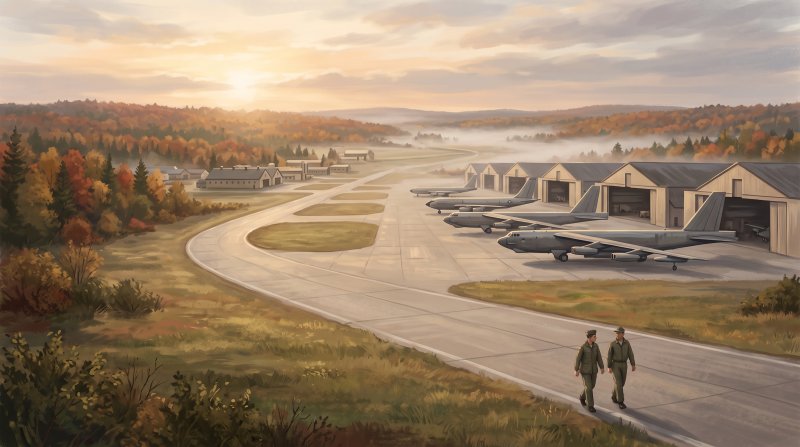
In 1947, the Strategic Air Command selected northeastern Maine for airfield construction because it was the closest point in the continental United States to Europe. Authorized that April as Limestone Army Air Field, the installation expanded across roughly 8,700 to 9,000 acres in the lower Aroostook River Basin, situated primarily in Limestone near Caswell. The post became active in February 1953 with the arrival of the 42nd Bombardment Wing under first wing commander Colonel Ramputi and 42nd Air Base Group commander Lieutenant Colonel William W. Pannis. In 1954, Limestone Air Force Base was renamed Loring Air Force Base in honor of Major Charles Joseph Loring Jr., a Portland, Maine native who received the Medal of Honor posthumously after dying in combat during the Korean War. The rapid operational growth reshaped the region, causing Limestone's population to quintuple between 1950 and 1960.
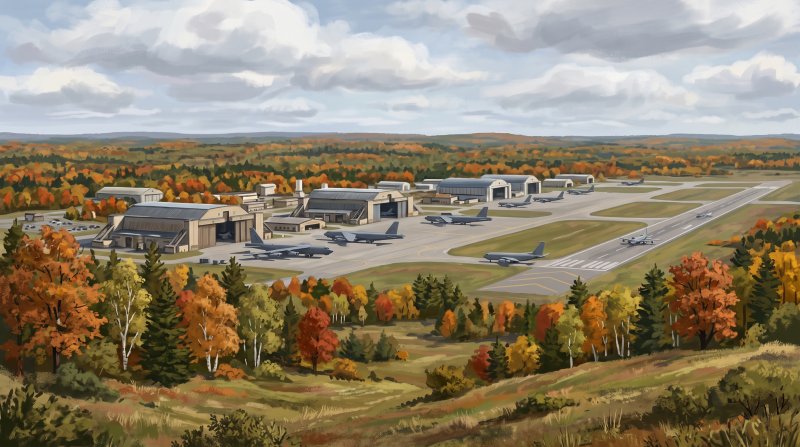
Throughout the Cold War, Loring hosted B-36 and B-52 bombers on continuous alert alongside KC-97 and KC-135 refueling aircraft for national nuclear deterrence. To shelter massive bombers like the B-36 Peacemaker, workers built a prominent monolithic arch hangar of reinforced concrete using reusable arched falsework. Next door, construction began in August 1951 on Caribou Air Force Station—also known as East Loring or North River Depot—which served as a top-secret operational storage site for atomic weapons until it was absorbed directly into Loring in 1962. To protect the installation against incoming Soviet bombers and missiles, the U.S. Army operated a defensive ring of Nike air defense missile silos across Caribou, Caswell, Connor, and Limestone.

After being placed on the federal Base Realignment and Closure list in 1991, Loring Air Force Base officially closed on September 30, 1994, eliminating roughly 4,500 military and over 1,000 civilian jobs, which brought an immediate economic setback and regional population decline. Airman First Class Hattie Douglas was the last airman assigned to the post, arriving in November 1993 as a relocation technician helping the personnel flight wind down operations. Redevelopment began promptly under the Loring Development Authority, created by the Maine Legislature to convert the developed acreage into the Loring Commerce Centre. Presque Isle native Carl W. Flora joined the authority in 1995 and served as president and CEO from 2005 until his retirement, while the runway facilities began operating as Loring International Airport in 1997, supported by a state sustainability and marketing initiative.
Today, the landscape reflects both renewal and history. In 1998, the U.S. Air Force transferred 4,700 acres to the U.S. Fish and Wildlife Service to create the Aroostook National Wildlife Refuge, where Cold War-era military structures and weapons storage remnants remain visible along the trails. At the Loring Commerce Centre, the volunteer-founded Loring Air Museum operates out of 131 Cupp Road in a former base bank building. Curated with the help of former B-52 navigator Ray Hildebrand, who served at Loring from 1976 until closure, the museum preserves photographs, gear, and records, while holding a 99-year lease to maintain the historic Sentry Dog Cemetery where 14 military working dogs rest. Through open house and reunion traditions on the flightline, veterans regularly return to Limestone, where historic aircraft such as the B-52 Stratofortress have once again landed on the runway.
Where to go: Central Aroostook
Every fact on this page comes from the sources listed below. Histories are told in many ways, so where sources differ we say so.
The facts behind this history
·
Background and causes (8)
- Base closure and employment losses Limestone
- Loring was officially closed on September 30, 1994, eliminating approximately 4,500 military jobs and over 1,000 civilian jobs, which led to a significant regional population decline.[1]
- Base construction footprint Limestone
- The installation was developed across roughly 8,700 to 9,000 acres in the lower Aroostook River Basin, situated primarily in Limestone near the border of Caswell.[2]
- Cold War operational role Limestone
- Loring served as a vital Strategic Air Command base hosting the 42nd Bombardment Wing, supporting B-36 and B-52 bombers along with KC-97 and KC-135 refueling aircraft for national nuclear deterrence.[3]
- Original authorization and name Limestone
- Construction of the airfield was authorized in April 1947, initially designated as Limestone Army Air Field before being renamed Limestone Air Force Base.[4]
- Population impact on Limestone Limestone
- The operational growth of the base dramatically expanded the local community, causing the population of Limestone to quintuple between 1950 and 1960.[5]
- Redesignation as Loring Air Force Base Limestone
- The base was renamed Loring Air Force Base in 1954 in honor of Major Charles J. Loring Jr., a Portland, Maine native awarded the Medal of Honor in the Korean War.[4]
- Redevelopment into Loring Commerce Centre Limestone
- Following the 1994 shutdown, the Maine Legislature created the Loring Development Authority to acquire the former base property and redevelop it as an industrial, aviation, and commercial park.[6]
- Strategic Air Command site selection Limestone
- In 1947, the Strategic Air Command selected Aroostook County as the site for a new base because its northeastern Maine location was the closest point in the continental United States to Europe.[4]
Key events and dates (7)
- Activation of Base and Stationing of 42nd Bombardment Wing Limestone
- The installation became active in 1953 with the arrival of the 42nd Bombardment Wing. Originally known as Limestone Air Force Base, it was renamed Loring Air Force Base in 1954 in honor of Major Charles J. Loring Jr.[7]
- Airport Operation and Conversion to Commerce Centre Limestone
- Following the base closure, the site transitioned into the Loring Commerce Centre, and its runway facilities began operating as Loring International Airport in 1997.[8]
- Aroostook County Selected for Airfield Construction Limestone
- In 1947, the New England Division of the U.S. Army Corps of Engineers selected land in Limestone Township and Caswell Plantation to build a major Strategic Air Command base because of its geographic proximity to Europe.[9]
- BRAC Base Closure Recommendation Limestone
- Loring Air Force Base was placed on the federal Base Realignment and Closure (BRAC) list by the U.S. Congress in 1991 for eventual decommission.[10]
- Creation of Loring Development Authority Limestone
- In 1993, the Maine Legislature established the Loring Development Authority as a public municipal entity tasked with managing and redeveloping approximately 3,800 acres of the installation.[11]
- Official Closure of Loring Air Force Base Limestone
- Loring Air Force Base officially closed on September 30, 1994, eliminating approximately 4,500 military and 1,100 civilian jobs, which substantially impacted the local Aroostook County economy.[12]
- State Redevelopment and Marketing Campaign Limestone
- The State of Maine funded a $400,000 initiative alongside the Loring Development Authority to execute a sustainability plan and recruit aerospace, aviation, energy, and commercial tenants to the former base.[13]
Legacy today (5)
- Aroostook National Wildlife Refuge Establishment Limestone
- In 1998, 4,700 acres of the former Loring Air Force Base were transferred from the U.S. Air Force to the U.S. Fish and Wildlife Service to establish the Aroostook National Wildlife Refuge.[14]
- Cold War Structures along Refuge Trails Limestone
- Remnants and Cold War-era military structures of Loring Air Force Base, including portions of the former weapons storage area, remain visible along trails throughout the Aroostook National Wildlife Refuge.[15]
- Loring Air Museum Limestone
- The Loring Air Museum, originally established by volunteers in 2005 as the Loring Military Heritage Center, preserves artifacts, equipment, photographs, and records from Loring Air Force Base. It operates inside a former base bank building in Limestone.[16]
- Loring Open House and Reunion Traditions Limestone
- The Loring Air Museum hosts open house and reunion events on the former base flightline, bringing veterans back to Limestone and featuring historic aircraft visits such as a B-52 Stratofortress landing.[17]
- Preservation of the Sentry Dog Cemetery Limestone
- The Loring Air Museum acquired oversight of the base's historic Sentry Dog Cemetery under a 99-year lease to restore and preserve the memorial plot where approximately 14 military working dogs were buried.[18]
People (6)
- Air Base Group Commander Lt. Col. William W. Pannis Limestone
- Lieutenant Colonel William W. Pannis became commander of the 42nd Air Base Group when the 42nd Bombardment Wing was activated at the Limestone base in February 1953.[19]
- B-52 Navigator Ray Hildebrand Limestone
- Ray Hildebrand served as a B-52 navigator at Loring Air Force Base from 1976 until its closure in 1994 and remained in Aroostook County to help curate historical exhibits at the Loring Air Museum.[20]
- Base Namesake Major Charles J. Loring Jr. Limestone
- Limestone Air Force Base was renamed Loring Air Force Base in 1954 in honor of Major Charles Joseph Loring Jr., a Maine native and posthumous Medal of Honor recipient who died in combat during the Korean War.[21]
- First Wing Commander Colonel Ramputi Limestone
- Colonel Ramputi assumed command of the 42nd Bombardment Wing upon its activation at the base on February 25, 1953, serving as its first wing commander.[19]
- Redevelopment Leader Carl W. Flora Limestone
- Presque Isle native Carl W. Flora joined the Loring Development Authority in November 1995 and served as its president and CEO from 2005 until his retirement, overseeing civilian reuse of the closed base.[22]
- Relocation Technician Airman First Class Hattie Douglas Limestone
- Airman First Class Hattie Douglas was the last airman assigned to Loring Air Force Base, arriving on November 1, 1993, as a relocation technician assisting with the personnel flight during base closure.[19]
Places (8)
- Base Closure and Economic Impact Limestone
- Loring Air Force Base officially closed on September 30, 1994, triggering an immediate regional economic setback that removed 4,500 active military personnel and more than 1,000 civilian base jobs.[23]
- Base Establishment and Initial Designation Limestone
- Airfield construction in northeastern Maine began under the U.S. Army Corps of Engineers in 1947, becoming operational in 1953 as Limestone Air Force Base before being renamed Loring Air Force Base in 1954 after Korean War Medal of Honor recipient Major Charles J. Loring Jr.[24]
- Caribou Air Force Station Nuclear Storage Limestone
- Adjacent to Loring, Caribou Air Force Station (also known as East Loring or North River Depot) began construction in August 1951 as a top-secret operational storage site for atomic weapons before being absorbed directly into Loring Air Force Base in 1962.[25]
- Cold War Strategic Air Command Role Limestone
- Loring Air Force Base served as a key Strategic Air Command base hosting the 42nd Bombardment Wing, which operated B-36 and later B-52 bombers on continuous alert due to the location being the continental United States' closest point to Europe.[19]
- Creation of Aroostook National Wildlife Refuge Limestone
- In 1998, 4,700 acres of former base land, including parts of the Cold War-era weapons storage compound, were transferred to the U.S. Fish and Wildlife Service to create the Aroostook National Wildlife Refuge.[26]
- Loring Commerce Centre Redevelopment Limestone
- The Maine Legislature formed the Loring Development Authority in 1993, which took ownership of approximately 3,700 acres of developed base property to convert into an industrial, aviation, and commercial complex known as the Loring Commerce Centre.[23]
- Monolithic Arch Hangar Limestone
- The base's prominent arch hangar was built out of reinforced concrete using reusable arched falsework to shelter heavy SAC bombers such as the B-36 Peacemaker.[19]
- Nike Air Defense Missile Ring Caribou
- To defend Loring Air Force Base against incoming Soviet bombers and missiles, the U.S. Army established and operated Nike air defense missile silos across Aroostook County communities, including Caribou, Caswell, Connor, and Limestone.[27]
Where to learn more (4)
- Loring 2024 Open House and B-52 landing Limestone
- To commemorate nearly 30 years since Loring Air Force Base closed, the Loring Air Museum organized the 2024 Loring Open House event featuring the landing of a B-52 Stratofortress at the former base.[28]
- Loring Air Museum establishment and purpose Limestone
- The Loring Air Museum, formerly known as the Loring Military Heritage Center, was founded by volunteers and veterans in Limestone to preserve artifacts and memories of Loring Air Force Base.[29]
- Loring Air Museum location and collection Limestone
- Located at 131 Cupp Road at the Loring Commerce Centre in Limestone, the museum houses artifacts, equipment, photos, and memorabilia representing the personnel, B-52 bombers, and refueling operations of the former base.[30]
- Loring Air Museum Sentry Dog Cemetery lease Limestone
- The Loring Air Museum secured a 99-year lease to restore and preserve the historic Loring Sentry Dog Cemetery, where approximately 14 service dogs that guarded the former base are buried.[31]
Sources (31)
- Where Aroostook stands 3 decades after losing its Air Force base - Bangor Daily News — bangordailynews.com , viewed Oct 16, 2026
- Site Profile - Loring AFB NPL Removal - EPA OSC Response — response.epa.gov , viewed Oct 16, 2026
- Loring Air Force Base Open House Revives Historic Legacy — 101arw.ang.af.mil , viewed Oct 16, 2026
- LORING HISTORY - LORING AIR MUSEUM — loringairmuseum.org , viewed Oct 16, 2026
- If you move to Maine's boom-and-bust Cold War town, you get a welcome packet - Loring Commerce Centre — loringcommercecentre.com , viewed Oct 16, 2026
- There is new hope for economic revival in Aroostook County - News Center Maine — newscentermaine.com , viewed Oct 16, 2026
- FORMER LORING AIR FORCE BASE COMMUNITY RELATIONS PLAN Appendix I — vertexaisearch.cloud.google.com , viewed Oct 16, 2026
- Loring's flight plan: Turning the former Air Force base into a regional aviation, aerospace hub — vertexaisearch.cloud.google.com , viewed Oct 16, 2026
- LORING HISTORY - LORING AIR MUSEUM — vertexaisearch.cloud.google.com , viewed Oct 16, 2026
- Site Profile - Loring AFB NPL Removal - EPA OSC Response — vertexaisearch.cloud.google.com , viewed Oct 16, 2026
- Where Aroostook stands 30 years after losing its Air Force base - The County — vertexaisearch.cloud.google.com , viewed Oct 16, 2026
- 30 years after its closure, veterans share memories of Loring Air Force Base - The County — vertexaisearch.cloud.google.com , viewed Oct 16, 2026
- Maine makes new push to revitalize former Loring Air Force Base — vertexaisearch.cloud.google.com , viewed Oct 16, 2026
- Aroostook National Wildlife Refuge — vertexaisearch.cloud.google.com , viewed Oct 16, 2026
- East Loring Trail - Aroostook National Wildlife Refuge - Maine Tourism Association — vertexaisearch.cloud.google.com , viewed Oct 16, 2026
- Loring Air Museum | Limestone Development Foundation & Chamber of Commerce — vertexaisearch.cloud.google.com , viewed Oct 16, 2026
- Loring Air Force Base Open House Revives Historic Legacy — vertexaisearch.cloud.google.com , viewed Oct 16, 2026
- A museum will preserve Loring's military dog cemetery - Bangor Daily News — vertexaisearch.cloud.google.com , viewed Oct 16, 2026
- LORING HISTORY - LORING AIR MUSEUM — loringairmuseum.com , viewed Oct 16, 2026
- 30 years after its closure, veterans share memories of Loring Air Force Base - The County — thecounty.me , viewed Oct 16, 2026
- Maj. Charles J. Loring Jr. - National Museum of the USAF - Air Force — nationalmuseum.af.mil , viewed Oct 16, 2026
- 2019 - MAINE STATE LEGISLATURE — legislature.maine.gov , viewed Oct 16, 2026
- 2025 - MAINE STATE LEGISLATURE — legislature.maine.gov , viewed Oct 16, 2026
- 30 years after its closure, veterans share memories of Loring Air Force Base - The County — thecounty.me , viewed Oct 16, 2026
- Loring Air Force Base, Weapons Storage Area, Northeastern corner of base at northern end of Maine Road, Limestone, Aroostook County, ME - The Library of Congress — loc.gov , viewed Oct 16, 2026
- Aroostook National Wildlife Refuge — fws.gov , viewed Oct 10, 2026
- How Aroostook once housed a massive nuclear weapons arsenal - The County — thecounty.me , viewed Oct 16, 2026
- Loring Air Force Base Open House Revives Historic Legacy — 101arw.ang.af.mil , viewed Oct 16, 2026
- LORING AIR MUSEUM — loringairmuseum.com , viewed Oct 16, 2026
- Loring Air Museum | Visit Aroostook — visitaroostook.com , viewed Oct 16, 2026
- A museum will preserve Loring's military dog cemetery - Bangor Daily News — bangordailynews.com , viewed Oct 16, 2026
Last updated October 17, 2026.