Acadian and French Settlement
The St. John Valley and its Acadian roots
Acadian and French settlement in Aroostook County began in 1785 when families journeyed up the Saint John River to establish a permanent haven in the Upper St. John Valley. Across communities like Madawaska, Grand Isle, Van Buren, and Fort Kent, the deep cultural roots, distinct architecture, and communal spirit of these early pioneers remain preserved today.
 Your logo here
This page could be sponsored
Your business name here
Sponsor This Page
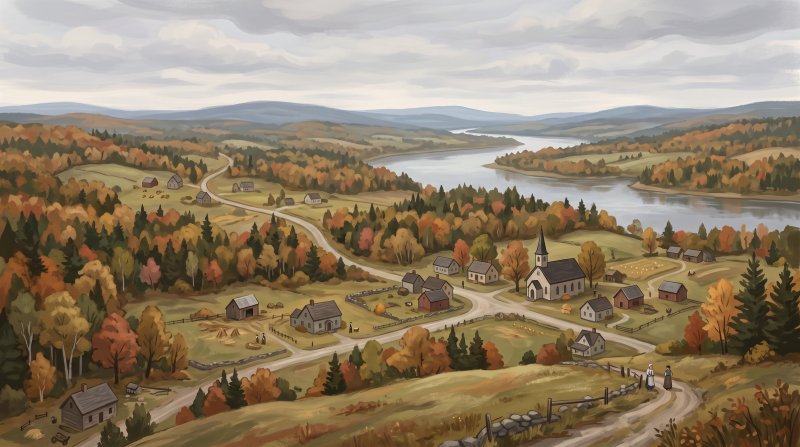
The story of Acadian and French settlement in Aroostook County traces back to the 1780s, when Acadians who had re-established homes in the lower St. John River Valley faced displacement following land grants given to British Loyalist refugees of the American Revolution. Moving upriver, families submitted a formal petition in 1785 to request settlement land in the Upper St. John Valley. In June 1785, the first group concluded an arduous canoe journey and landed on the southern shore in what became St. David parish in Madawaska. Led nominally by Joseph Daigle, the settlers raised a wooden cross to give thanks for their safe haven. Today, the Acadian Landing Site in St. David, listed on the National Register of Historic Places, features a 14-foot marble cross commemorating that symbolic original marker.
Over the following decades, the community expanded across a 45-mile stretch along the upper valley and major tributaries like the Fish River, growing to roughly 2,500 French and Acadian settlers by 1831. Surviving in the northern borderlands required immense resilience, exemplified during an acute food shortage following an early frost in 1797. Marguerite Blanche Thibodeau Cyr, remembered as Tante Blanche, traveled on snowshoes to collect and distribute rations and clothing to save families from starvation; her deeds are preserved at the Tante Blanche Museum complex, which features a 19th-century schoolhouse and the mid-19th-century Fred Albert House. In 1842, the Webster-Ashburton Treaty established the international boundary along the Saint John and St. Francis rivers, dividing the once-unified Madawaska settlement across two nations while recognizing existing land titles on the Maine side. Adapting to civic life, prominent Acadian businessman Joseph D. Cyr was elected as Madawaska's first representative to the Maine State Legislature in 1846, and in 1913, St. David Catholic Church was consecrated to serve the first separate congregation formed after the border division.
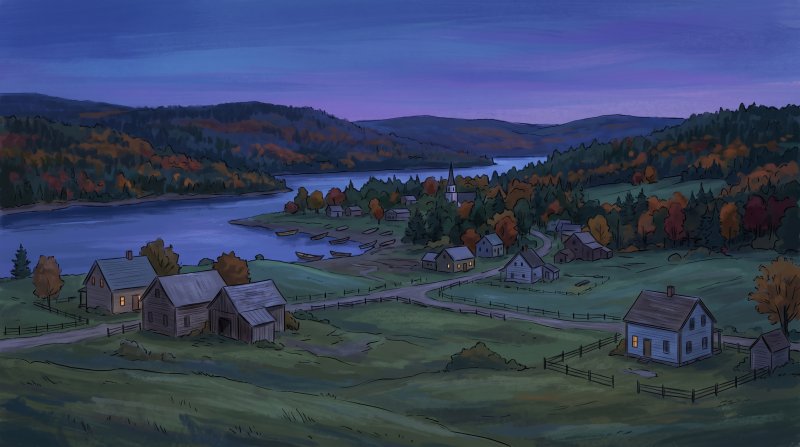
The unique traditions and architecture of the valley continue to stand along the river corridor. In Grand Isle, contractor Léonide Gagné constructed the wooden Notre Dame du Mont-Carmel Catholic Church in 1909, which now houses the Musée Culturel du Mont-Carmel displaying regional religious artifacts, textiles, and tools. Downriver in Van Buren, the open-air Acadian Village, established through the volunteer historical society Notre Héritage Vivant, preserves 17 historic and replica structures, including the Notre Dame de L'Assumption Chapel replica and the 1850s Morneault House, which demonstrates classic squared-timber pièce-sur-pièce framing, Georgian massing, and interior ship knees used for structural support. In Fort Kent, the Acadian Archives at the University of Maine at Fort Kent, created by the Maine State Legislature in 1989, safeguards manuscripts, oral histories, and genealogical records, ensuring that the legacy documented by Father Thomas Albert in his 1920 Histoire du Madawaska endures for future generations.
Where to go: St. John Valley
Every fact on this page comes from the sources listed below. Histories are told in many ways, so where sources differ we say so.
The facts behind this history
·
Background and causes (7)
- 1785 Upper St. John Valley Land Petition Madawaska
- Archival records confirm that the first formal petition to request settlement land in the Upper St. John Valley was submitted in 1785, marking the formal beginning of permanent Acadian and French settlement in Aroostook County.[1]
- Acadian Archives Research Center Fort Kent
- The Acadian Archives (Archives acadiennes), located at the University of Maine at Fort Kent, serves as a primary regional center preserving documents, genealogical records, and oral histories of St. John Valley French settlement.[2]
- Acadian Cross Historic Shrine Madawaska
- The Acadian Landing Site in St. David features a 14-foot marble cross commemorating the symbolic wooden cross erected in 1785 by the original Acadian settlers to give thanks for their safe haven and land.[3]
- Acadian Village Heritage Preservation Van Buren
- The Acadian Village in Van Buren contains 17 historic structures depicting traditional Acadian building techniques and preserves the heritage of French-Acadian families who settled the St. John Valley.[2]
- Displacement Leading to Upper St. John Settlement Madawaska
- Acadians who had re-established homes in the lower St. John River Valley faced displacement in the 1780s due to the influx and land grants given to British Loyalist refugees of the American Revolution, prompting their move upriver into northern Aroostook County.[4]
- First Acadian Landing in St. David Madawaska
- In June 1785, the first group of Acadian families concluded an arduous journey up the St. John River and landed on the southern shore in what became St. David parish in Madawaska.[3]
- Webster-Ashburton Treaty Division Madawaska
- The 1842 Webster-Ashburton Treaty established the St. John and St. Francis rivers as the international boundary, dividing the Acadian settlement across two nations while recognizing existing land titles on the Aroostook County side.[5]
Key events and dates (7)
- Acadian Landing in Madawaska Madawaska
- In June 1785, the first group of Acadian families arrived by canoe up the Saint John River and established a permanent settlement in the area of present-day St. David parish. A wooden cross was erected upon landing to give thanks, later commemorated by the Acadian Cross Historic Shrine.[6]
- Construction of the Morneault House Grand Isle
- The Morneault House was built between 1855 and 1857 in Grand Isle by Charles Morneault, illustrating the classic squared-timber piece-sur-pièce framing and Georgian massing distinctive to mid-19th-century Maine Acadian domestic architecture.[7]
- Establishment of the Acadian Village Van Buren
- In 1973, the volunteer historical society Notre Héritage Vivant was formed to safeguard local French-Acadian heritage, subsequently creating an open-air living history complex that preserves 17 historic and reproduction buildings representing 19th-century Acadian rural life.[8]
- Famine of 1797 and Tante Blanche Madawaska
- During an acute food shortage following an early frost in 1797, Marguerite Blanche Thibodeau Cyr served as a central humanitarian figure, traveling on snowshoes to collect and distribute rations and clothing to starving Acadian and French families. Her memory is preserved at the Tante Blanche Museum complex.[9]
- National Register Listing of Acadian Landing Site Madawaska
- On September 20, 1973, the Acadian Landing Site in Madawaska was placed on the National Register of Historic Places in recognition of its symbolic and historical significance to the Acadian settlement of northern Maine.[10]
- Valley Settlement Growth by 1831 Fish River
- By 1831, roughly 2,500 French and Acadian settlers had populated a 45-mile stretch along the upper Saint John Valley in what is now northern Aroostook County, expanding along major river mouths and tributaries such as the Fish River.[11]
- Webster-Ashburton Treaty Boundary Saint John River
- The 1842 Webster-Ashburton Treaty established the international boundary along the Saint John River, dividing the once-unified Madawaska Acadian settlement and placing the communities on the southern bank permanently under the jurisdiction of Maine and the United States.[12]
Legacy today (5)
- Acadian Archives at UMFK Fort Kent
- The Acadian Archives (Archives acadiennes) at the University of Maine at Fort Kent was established by the Maine State Legislature in 1989. It serves as a regional repository documenting, preserving, and sharing records, manuscripts, and oral histories of the Upper St. John Valley's Acadian and Franco-American people.[13]
- Acadian Landing Site and Cross Shrine Madawaska
- The Acadian Landing Site in St. David marks where the first Acadian settlers arrived along the upper St. John River in 1785. A 14-foot marble cross commemorates the wooden cross originally erected by the settlers upon landing, and the site is listed on the National Register of Historic Places.[14]
- Acadian Village Historical Complex Van Buren
- The Acadian Village is an open-air folk museum complex comprising 17 historic and replica buildings representing 18th- and 19th-century Acadian culture and distinct construction methods. Listed on the National Register of Historic Places, it includes the 1850s Morneault House, a reconstructed blacksmith shop, and the Notre Dame de L'Assumption Chapel replica.[15]
- Musée Culturel du Mont-Carmel Grand Isle
- The Musée Culturel du Mont-Carmel is housed in the former Notre-Dame du Mont-Carmel Catholic Church in the village of Lille, one of the few surviving historic wooden Catholic churches in the St. John Valley. Listed on the National Register of Historic Places, the cultural museum preserves regional Acadian and French-Canadian artifacts, furnishings, and liturgical items.[16]
- Tante Blanche Museum Complex Madawaska
- The Tante Blanche Museum complex, operated by the Madawaska Historical Society, is named after Marguerite Blanche Thibodeau Cyr for her assistance during the 1797 famine. The complex preserves local Acadian textile artifacts, domestic furnishings, a 19th-century schoolhouse, and the historic mid-19th-century Fred Albert House.[14]
People (6)
- Anselme and Luke Albert homestead construction Madawaska
- Early French settlers François Albert Jr. and his wife Marie Anne secured land in the Madawaska territory by 1806, transferring property to son Anselme Albert, who with his son Luke Albert built a distinctively Maine Acadian pièce-sur-pièce dwelling.[14]
- Father Thomas Albert documenting Acadian valley settlement Madawaska
- Father Thomas Albert wrote the canonical history Histoire du Madawaska in 1920, documenting the 1785 Acadian landing, the founding of early parishes, and the genealogy of pioneer families in the Upper St. John Valley.[17]
- Joseph D. Cyr elected first legislative representative Madawaska
- In 1846, prominent Acadian businessman Joseph D. Cyr was elected as the first representative from Madawaska to serve in the Maine State Legislature.[18]
- Joseph Daigle erecting Acadian landing cross Madawaska
- In June 1785, Joseph Daigle served as the nominal leader of the first group of Acadian families who canoed up the St. John River and erected a wooden cross on the south shore to mark their arrival in the Madawaska region.[18]
- Léonide Gagné construction of Mont-Carmel Church Grand Isle
- Contractor Léonide Gagné constructed the wooden Notre Dame du Mont-Carmel Catholic church in Lille in 1909 to serve the local Acadian and French-speaking parish.[16]
- Marguerite Blanche Thibodeau Cyr relief during 1797 famine Madawaska
- Marguerite Blanche Thibodeau Cyr, known as Tante Blanche, performed heroic deeds by collecting and distributing food and clothing to save St. John Valley families from starvation during the severe famine of 1797.[14]
Places (7)
- Acadian Archives / Archives acadiennes Fort Kent
- Located at the University of Maine at Fort Kent, the Acadian Archives serve as a regional research center preserving documents, genealogical records, and audiovisual collections on St. John Valley Acadian history and culture.[2]
- Acadian Landing Site Madawaska
- The Acadian Landing Site commemorates the arrival of the first Acadian settlers in the upper St. John Valley in 1785, where a large cross was traditionally erected upon landing. The two-acre property was placed on the National Register of Historic Places in 1973.[19]
- Acadian Village Historic Complex Van Buren
- The Acadian Village in Van Buren is a living history complex of 17 buildings overlooking the St. John River, preserving the cultural heritage and craftsmanship of 18th- and 19th-century Acadian settlers.[15]
- Fred Albert House Madawaska
- Constructed in the mid-19th century by Acadian settlers and later moved to the museum complex in St. David, the Fred Albert House displays distinctive Maine Acadian architectural features and domestic furnishings.[19]
- Morneault House Nautical Construction Van Buren
- The Morneault House, built between 1855 and 1857 and preserved at the Acadian Village, incorporates nautical ship knees as architectural structural supports typical of distinct Maine Acadian building techniques.[15]
- St. David Catholic Church Madawaska
- Consecrated in 1913, St. David Catholic Church serves the first separate Roman Catholic congregation established in Madawaska after the 1842 border treaty divided the local valley parish community.[20]
- Tante Blanche Museum Complex Madawaska
- Named for Marguerite Blanche Thibodeau Cyr in recognition of her aid during the 1797 famine, this museum complex includes a 1970s log museum building, a 19th-century schoolhouse, and historical Acadian artifacts.[19]
Where to learn more (7)
- Acadian Cross Landing site Madawaska
- The Madawaska Historical Society maintains the Acadian Cross Landing site on the banks of the St. John River in St. David, which commemorates the symbolic 1785 arrival point of the first Acadian settlers in the Upper St. John Valley.[21]
- Acadian Village living history complex Van Buren
- The Acadian Village in Van Buren contains 17 historic buildings and replicas dating back to the late 1700s and 1800s that showcase Acadian construction, domestic life, and settlement in the St. John Valley. Owned and operated by Notre Héritage Vivant, the site is listed on the National Register of Historic Places.[22]
- Establishment of the Acadian Archives Fort Kent
- The Acadian Archives (Archives acadiennes) at the University of Maine at Fort Kent was created in 1989 by an act of the Maine State Legislature. The repository preserves and shares manuscripts, audio-visual records, and genealogical material documenting the French and Acadian heritage of the Upper St. John River Valley.[13]
- Maine Acadian Culture published report Fort Kent
- In 1994, the National Park Service published 'Acadian Culture in Maine,' a 92-page historical and cultural documentation report detailing the early French and Acadian settlement and traditions along Maine's Upper St. John River Valley.[23]
- Morneault House at Acadian Village Van Buren
- The Morneault House, built between 1855 and 1857 and relocated to the Acadian Village, displays distinct Maine Acadian construction including interior ship knees used for structural support.[22]
- Musée culturel du Mont-Carmel preservation Grand Isle
- The Musée culturel du Mont-Carmel is situated in the former Notre-Dame du Mont-Carmel Catholic Church in the village of Lille within Grand Isle, which was originally built in 1908–1909 and listed on the National Register of Historic Places in 1973. The museum exhibits Acadian and French-Canadian artifacts, textiles, tools, and religious history from the St. John Valley.[24]
- Tante Blanche Museum complex Madawaska
- The Madawaska Historical Society operates the Tante Blanche Museum complex in St. David, which exhibits early Acadian settlement artifacts, an ancestral homestead, and a schoolhouse.[21]
Sources (24)
- Settling the Upper St. John Valley - Acadian Culture in Maine — acim.umfk.edu , viewed Oct 16, 2026
- Places To Go - Maine Acadian Culture (U.S. National Park Service) — nps.gov , viewed Oct 16, 2026
- Acadian Landing & Tante Blanche Museum - National Park Service — nps.gov , viewed Oct 16, 2026
- Maine Acadians - Saint Croix Island International Historic Site (U.S. National Park Service) — nps.gov , viewed Oct 16, 2026
- American-Canadian Boundary - Acadian Culture in Maine — acim.umfk.edu , viewed Oct 16, 2026
- Acadian Landing & Tante Blanche Museum - National Park Service — nps.gov , viewed Oct 9, 2026
- Acadian Village - Acadian Culture in Maine — acim.umfk.edu , viewed Oct 16, 2026
- Acadian Village - Maine Acadian Culture (U.S. National Park Service) — nps.gov , viewed Oct 16, 2026
- Acadian Landing Site - Acadian Culture in Maine — acim.umfk.edu , viewed Oct 16, 2026
- Acadian Landing Site - Wikipedia — en.wikipedia.org , viewed Oct 16, 2026
- Settling the Upper St. John Valley - Acadian Culture in Maine — acim.umfk.edu , viewed Oct 16, 2026
- Aroostook County Maine History by Dr. Dena Winslow — aroostookhistory.me , viewed Oct 16, 2026
- History & Culture - Maine Acadian Culture (U.S. National Park Service) — nps.gov , viewed Oct 9, 2026
- Acadian Landing & Tante Blanche Museum - National Park Service — nps.gov , viewed Oct 9, 2026
- Acadian Village - Maine Acadian Culture (U.S. National Park Service) — nps.gov , viewed Oct 9, 2026
- Musée culturel du Mont-Carmel - Maine Acadian Culture (U.S. National Park Service) — nps.gov , viewed Oct 16, 2026
- Settling the Upper St. John Valley - Acadian Culture in Maine — acim.umfk.edu , viewed Oct 16, 2026
- National Register of Historic Places Inventory -- Nomination Form - NPGallery — npgallery.nps.gov , viewed Oct 16, 2026
- Acadian Landing & Tante Blanche Museum - National Park Service — nps.gov , viewed Oct 16, 2026
- Pastor, church, and rectory of St. David, Madawaska, ca. 1916 - Maine Memory Network — mainememory.net , viewed Oct 16, 2026
- Madawaska Historical Society — stjohnvalleychamber.org , viewed Oct 16, 2026
- Acadian Village - Maine Acadian Culture (U.S. National Park Service) — nps.gov , viewed Oct 9, 2026
- Acadian Culture in Maine - University of Maine at Fort Kent — acim.umfk.edu , viewed Oct 16, 2026
- Musée culturel du Mont-Carmel - Maine Acadian Culture (U.S. National Park Service) — nps.gov , viewed Oct 16, 2026
Last updated October 16, 2026.